- Recorded
- 23 May 2026
- Quarter
- East end
- Air
- 88 F at the start
- Sky
- Bright, hazy, still
- On foot
- 0.9 miles, about 55 minutes
Record 04
An icehouse, a scrap yard, and one shared fence
Two uses that no map would put together, doing so under the same live oak, with a fence between them that both sides lean on.
Nine parcels, two of them combined into the yard, which takes about half the block. An icehouse here is a building type, not a brand: open sided, roofed, cold drinks, no doors.
The icehouse is a roof on posts with a service counter along one wall and no doors anywhere. Picnic tables under the roof, a concrete slab, a live oak at the corner of the slab that is older than the building and probably older than the block.
The fence at the back of the slab is chain link with slats missing. Behind it is the yard: a metal recycling operation with a scale, two loaders and a wall of baled material about twelve feet high.
What stands here
Along the front: the icehouse, a small brick building that is now an insurance office, two houses, and a taco stand that was closed and looked permanently so. Along the side: the yard, and the yard again. At the back: the yard's gate, a warehouse belonging to nobody visible, and a house facing away from all of it.
The two clocks
This is the part worth walking for. The two big uses on this block run on clocks that overlap for about four hours.
- The yard opens at seven and the loaders start immediately. By eleven the noise is constant and the dust is visible in the light coming through the trees.
- The icehouse opens at eleven. From eleven to three the two are running together, and the tables closest to the fence stay empty while the far ones fill.
- At three the yard's intake slows. By four the loaders are parked.
- From four onward the block belongs entirely to the icehouse, and the tables by the fence are the best ones, because the oak shades them and the fence is warm.
The four hour overlap is the whole arrangement. In a zoned city the two uses would be a mile apart and the oak would be in neither of them.
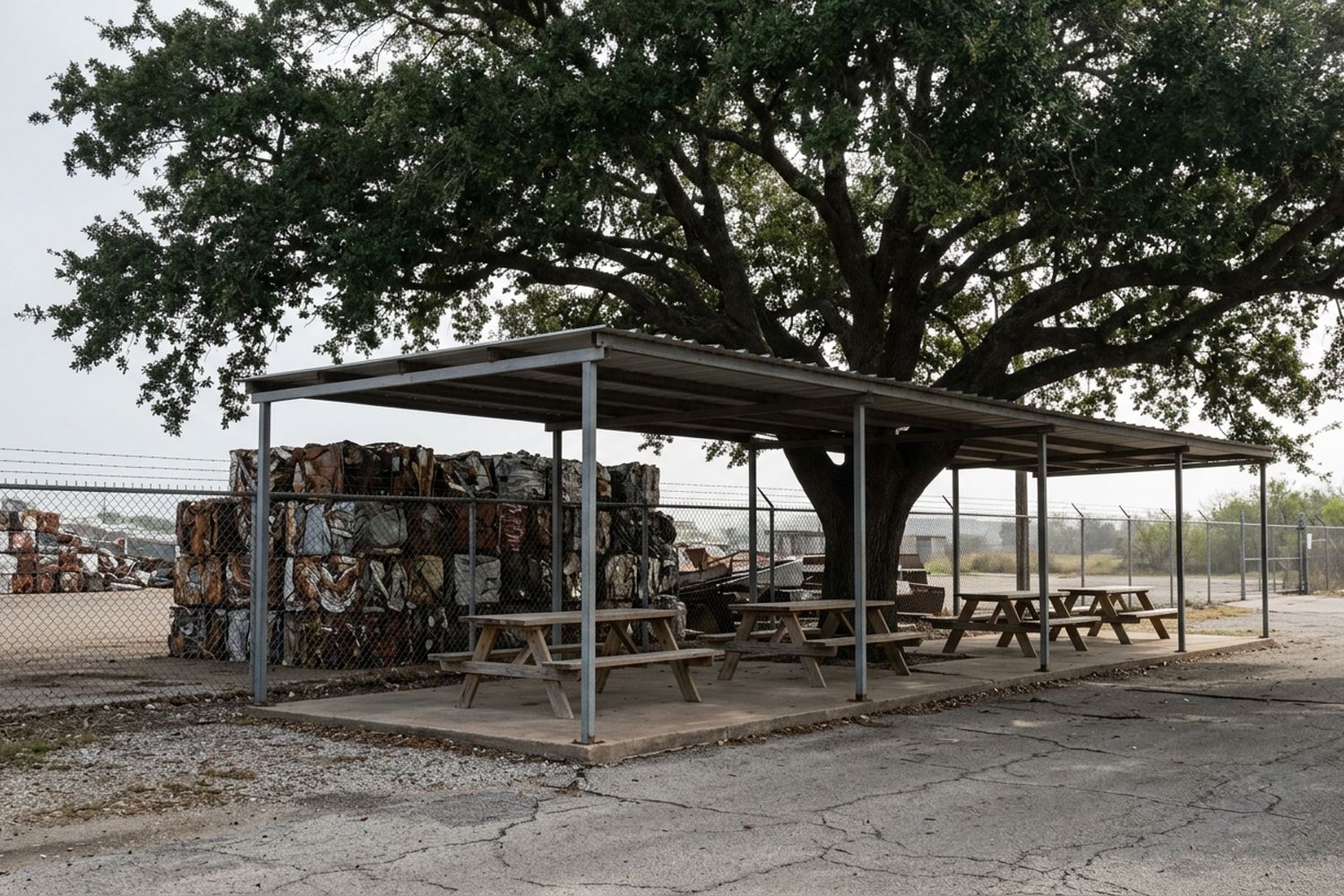
What the arrangement produces
- A price on the block's noise, paid in table choice. Nobody had to legislate it. The empty tables are the legislation.
- Dust on the fence side and none on the street side, visible as a line on the slab.
- A car park shared without agreement. The yard's customers use the icehouse's gravel in the morning; the icehouse's use the yard's frontage in the evening. Nobody had a meeting about it.
- A tree that both sides protect. The oak is on the icehouse parcel and shades the yard's scale house. It is the only thing on this block that everybody is on the same side of.
- A smell, faintly, of hot metal, which arrives with the breeze and leaves with it.
Walking it
Pavement along the front only, in poor repair, with two driveways and no kerb cuts. The yard's two sides have a gravel verge and heavy lorry traffic in the morning; walk them before nine or after four, or not at all.
Nine tenths of a mile with the return, fifty five minutes, done between seven and eight in the morning to have the yard side to oneself.
What it tells you
That incompatibility is mostly a matter of hours rather than of distance. These two uses are incompatible for four hours a day and entirely compatible for the other twenty, and a map drawn to prevent the four hours would also have prevented the twenty.
The fence here does more work than any ordinance would. It is four feet of chain link with slats missing, and both sides have decided that is enough.