- Recorded
- 18 April 2026
- Quarter
- Southwest
- Air
- 79 F at the start
- Sky
- Thunderheads building to the north
- On foot
- 0.7 miles, about 45 minutes
Record 03
No pavement, no kerb, and two feet of ditch on both sides
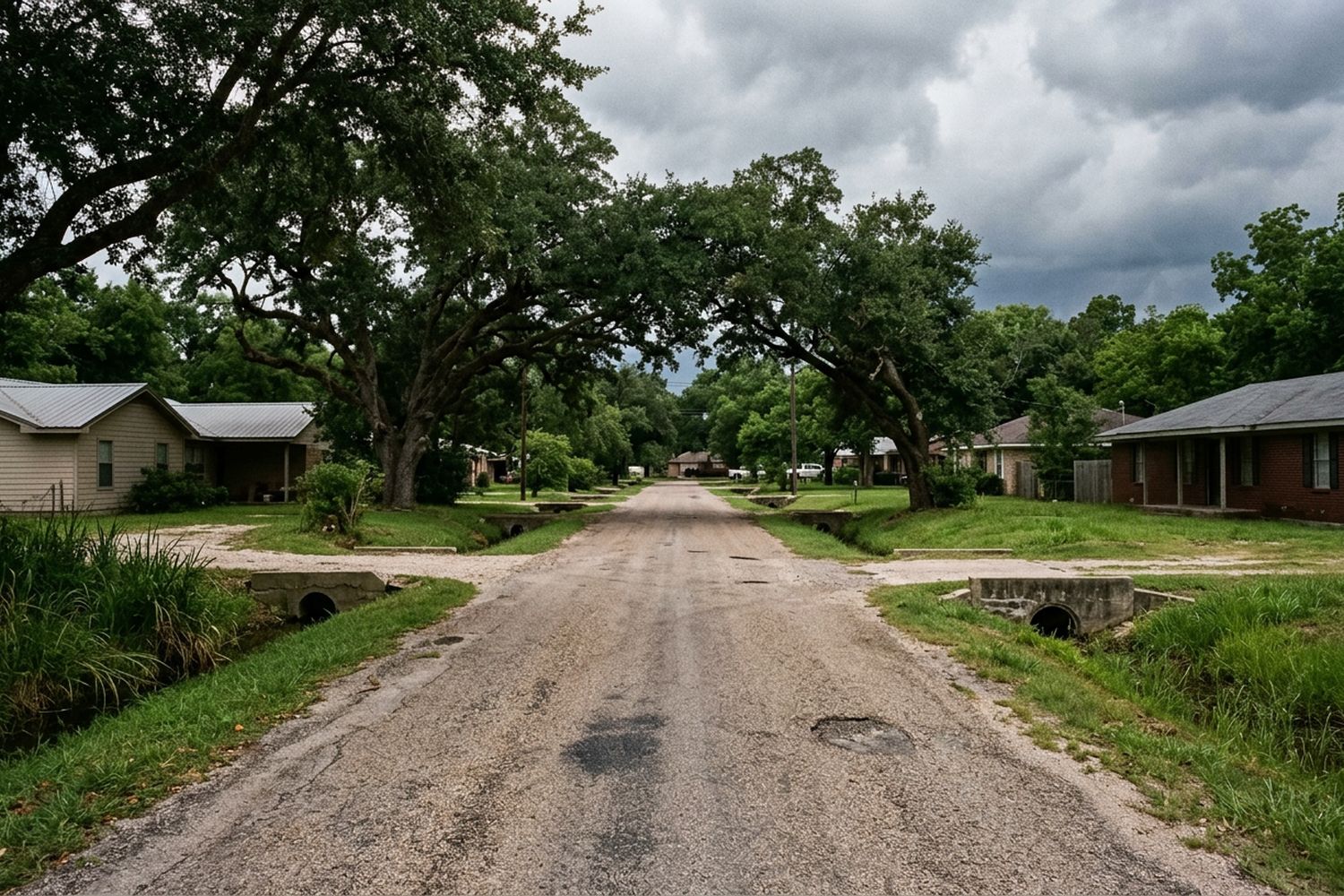
Roughly a third of the residential street mileage in this city drains into an open ditch rather than a pipe. This block is what that looks like from the middle of the road.
Twelve parcels, eleven driveways, and no continuous walking surface on either side. This is not neglect; it is the older standard, and it still works.
The road here is asphalt with no kerb. On each side the ground falls away about two feet into a grassed ditch, and beyond the ditch is grass, then a fence or a lawn, then a house. Every driveway crosses the ditch on a culvert pipe with a concrete headwall, and the eleven of them are the only flat places to stand.
You walk this block in the road. Everybody does. The road is wide enough for it and, on a Saturday morning, quiet enough.
What stands here
Ten houses, all single storey, most from the fifties, several enlarged. One of them has a second dwelling at the back with its own meter. A small church occupies two combined parcels at the near corner with a gravel car park. At the far corner is a tyre business in a metal building with six cars waiting on the grass.
Nothing here is remotely the same as anything else, and it is entirely unremarkable to everybody who lives on it.
The ditch, which is the real subject
A ditch here is not a failure to build a pipe. It is storage. A pipe carries; a ditch holds while the storm passes and then lets go slowly.
This city is flat, has clay soil that sheds water, and gets rainfall in quantities that arrive in an hour rather than a day. An open ditch does something a pipe cannot: it holds a volume of water on the surface, at zero cost, and releases it slowly.
The visible evidence on this block, on a day two weeks after rain:
- A silt line on the culvert headwalls about eighteen inches up, which is how high the ditch ran.
- Grass grown differently in the bottom of the ditch from the sides, in a distinct stripe.
- One driveway culvert crushed at the mouth, which will make the next storm interesting for the two houses upstream of it.
- A mown ditch on eight parcels and an unmown one on four, and you can see where the water slows down.
What the arrangement produces
- Walking in the road, which on a quiet block is fine and on a busy one is the reason people drive to a park to walk.
- No kerb parking. Cars go on the driveway or on the grass. The kerbside as an idea does not exist here.
- Trees that survive. With no kerb and no pipe, the verge is wide and undisturbed, and this block has the biggest oaks of any in the run.
- A hard boundary for anybody on wheels. No pavement and no continuous flat surface means a wheelchair uses the road with the cars. That is worth stating plainly rather than describing this block as charming.
- Mosquitoes, in the corner where the ditch is unmown.
Walking it
Seven tenths of a mile round with the return, forty five minutes, in the road for all of it. Two crossings, neither marked. The tyre business end has cars parked into the ditch line and you walk further out to pass them.
Do it before ten in the morning between May and October. On this day, at seventy nine degrees with a thunderhead visible to the north, the last ten minutes were done at a pace chosen by the weather.
What it tells you
That the most consequential decision on a block is often not what was built on it, but whether the street was finished. A ditch section says the block was developed before a standard arrived, and nothing since has been worth the cost of changing it.
A block with no pavement is not a poor block or a neglected one. It is an old block whose street was built to drain rather than to walk.